Sunday, January 31, 2010

The Tucos of Los Pozuelos


Last May, John and Eileen and Rachel, my labmate, went to the Los Pozuelos field site for the first time. They had been told by Pablo Cuello, a grad student in the university at Mendoza, Argentina, who had assisted us the year before and knew what a social tuco was, that the tucos he was seeing at this high altitude location looked suspiciously social. Not only were there lots of them in one area, one or more adults could be seen coming out of the same hole. It didn't take John and Eileen long, once they got there, to see that the tucos were social, and one of the primary reasons for this second trip was to confirm by radio telemetry that the areas individuals were using really did overlap.

Tissue sample was collected last May and we are still waiting for the genetic results from the lab in Mendoza but originally, this species was identified as Ctenomys opimus, which, from observations in other places, was characterized as a solitary animal. We are anxious to find out where this animal places in the known species of Ctenomys and if it truly is opimus or some subspecies or perhaps, something altogether different. Any of those possibilities are exciting... however, one thing is certain, the tucos that live in this area are social but do not exhibit the same social patterns we see in C. sociabilis in Patagonian Argentina.

In C. sociaibilis, we find females living in distinct colonies along with one adult male. Here, after MANY hours of radio telemetry (just ask Anna, the grad student who came out to join us!), we found that multiple males and multiple females overlap in the areas they use but not completely. The data are still being picked apart and analyzed but it looks like there are distinct groups but the groups don't necessarily inhabit the same space all the time. In addition, we did 3 nights of radio telemetry. There were 22 animals with radio collars and every hour on the hour all through the night and day, fixes were being made so we knew exactly where each individual was for that moment. This was no small feat... and I had to ask myself more than once, what the heck an almost 50 year old woman was doing out in the middle of nowhere in the middle of the night stumbling around in the dark with an antenna in her hand looking for a rodent!

However, we did collect a lot of information and are trying to better understand the unique society this mystery tuco participates in. The other big question we are asking is what the mating and breeding cycle is. Last May, they found fairly large pups. In January, we saw a number of pregnant females but also some decent sized pups. The picture in this post is one of them. Do these tucos breed multiple times through the year? Or are females on different reproductive cycles? With multiple males living in the same group, is there competition for mating or is there one male dominating? Who disperses? Who stays? Although I found this place to be a rather intense field site, I have to admit that these tucos intrigue me. There are so many things to discover, and discovering the stories of animals is what excites me most in biology. More to tell in the next post!

Monday, January 25, 2010

Field Site #2

So, I'm happily back at home and thought that I would take the next couple of weeks to post pics and memories of the second field site we went to in the north central part of Argentina. I wrote earlier that we were headed to Jujuy (which, yes, is fun to say) but actually we were a 4 hour drive north in a place called Los Pozuelos. The nearest town was about an hour drive, due to the rough dirt roads.

The field site here was so much different than what I have experienced in Patagonia. The tucos live next to a river in a gravelly soil with low growing vegetation. There are no trees and no shade. We were there in the wet season, and often, the clouds gathered every afternoon. Sometimes there was rain but always there was lightning and thunder. The high altitude (~13,000 ft) was a challenge but coca leaves and aspirin helped with the headaches, and in time, even the sluggish feeling left. The glare of the afternoon sun was overwhelming and the only relief was to sit in the truck.

The days were spent watching tucos, catching tucos, collaring tucos with radios and tracking them with telemetry. Often we were out for 12+ hours. It was rather intense, especially after having just completed a field season elsewhere. Still, a ton of data was collected and a lot was learned. Next posting, I'll write about these mysterious tucos, which we know are social but don't know what species they are.

Sunday, January 17, 2010

On the Beach


Well, it's been nearly a month now and I haven't posted a thing. You'd think from these pictures, I've only been relaxing and playing but inbetween, there's been a heck of a lot of field work in a completely different Argentina than I have seen before. Over the next couple of weeks, I will post the story of Jujuy or really, north of Jujuy, in a place called Los Pozuelos where we spent 3 weeks catching a tuco whose identity is not clearly known. The field site is a much harsher landscape than what I'm use to down near Bariloche, but the tucos are fascinating. They are definitely social but with different social habits than sociabilis.

I arrived in Mar del Plata, a city south of Buenos Aires and known as one of the hot vacation spots in Argentina, on 12 Jan after depositing my paperwork for permits in Buenos Aires. John, Anna and I (Eileen has gone home to teach classes) are hanging on the beach with good friends, Ana Paula and Alfredo, relaxing, eating asado and John is in heaven playing volleyball. I know you all feel sorry for me... not! But really, besides still missing home, I have come down with some stomach "bug" which has not made the time entirely perfect. Fortunately, Alfredo is a doctor and I am hoping the meds he suggested will work. Anna (fellow student from Berkeley) and I will head back to BA on Tuesday to finish up with permits and meet John for our flight home on Wednesday night. I have much more to tell and great pics to post over the next few weeks. Thanks for all the comments and emails... no worries to those of you who find this blog thing a bit complicated. Soon!

Friday, December 18, 2009

Moving On


On Tuesday, we packed up camp and left our refuge in the willows for new adventures. The season with C. sociabilis went fast, and tomorrow, we head for the north part of Argentina to investigate another social tuco-tuco. The past few days were spent outside a small town, El Maiten, south of Bariloche. Years ago, some professional animal collectors found a bunch of tucos living in a valley. Their report was that these tucos were up everywhere and "chirped like birds". That's classic sociabilis. Since then, some local mammalogists checked out the area and found burrows but did not see the animals. We went to see for ourselves just what tuco was living there. As it turned out, it was C. haigi, a solitary tuco known around Bariloche. Even though this species is found close to where we find soci, I had not yet met haigi up close and personal. We caught a mom and her pups and two males. They communicated more with grunts, rather than chirps, and were quite docile.

Today's picture shows John and Eileen on one of our last nights in camp. Like I said, the weather finally turned warm and we were often eating dinner outside. John has taken up guitar playing and brought his travel guitar with him, practicing all the time. Eileen, of course, continues to work even "after hours". By 9 pm or so, we hunker down in the truck for our nightly video of House. We're now on Season 3, and watching it has become our favorite tuco team past-time. I am hoping to post some more from Jujuy and parts north, but until then, I send my wishes to you all for a wonderful Christmas. Cross your fingers for me on Tuesday... we head to 14,000+ feet altitude and I am hoping that I don't get sick! From Bariloche, Felices Fiestas!!

Wednesday, December 9, 2009

Spring, Glorious Spring


Finally, spring has arrived in the Limay River Valley! It has turned wonderfully warm, so warm that the wind is a welcome friend. We’ve had a few sprinkles of rain but the temps are good enough to take a bath in the stream. We are now upon our last week of field work for C. sociabilis. It has been an interesting field season, surprising with who we’ve found has survived. Overall, older females seemed to do better than yearlings and even more of a surprise, there has been an adult male in nearly every colony! Those of you who know the tuco-tuco story know that male survival is quite low in this species, and in fact, we rarely encounter an adult male. It’s a good year when about 40% of the colonies have a male. So why such a difference this year? While they had rain in May (their Fall), they had little rain through the winter when tucos are mating. Perhaps, mortality was very high for last year’s litters, but I’m not sure if lowered competition for the males gave those remaining a better chance at survival. Who knows? But we also have seen a strong male sex ratio bias in the pups. And finally, I have only come across one lone female. The rest are living in groups this year. I have seen this downward trend toward fewer and fewer females living alone over the past 6 years. I am anxious to go back over the data to see if there may be a pattern that emerges with weather, yearling survival, sex ratio and number of lone to group colonies.

Today’s photo show a little pup and his generous donation to my dissertation cause. I do need more than one poop to get a sufficient sample of CORT hormones but he came through with more! I’ve collected a fair amount of samples and will add it to what I’ve already analyzed in the lab. In general, I have found that group living females have lower baseline CORT (or stress) hormones than females living alone. I have also found that CORT in pups is also high or low depending on living with a lone mom or group living moms. How much of that is inherited or passed through mom’s milk is yet to be known, but it is interesting to me. With the help of the best undergrad “wranglers” ever, I continue to run behavior tests with the pups in the lab at Berkeley, looking to see if behavior and hormones are correlated. Specifically, I am testing exploratory or bold behavior in an open arena in which they have the option of running around or hiding in a refuge. We have found in the adult lab females that there’s a strong correlation with CORT and boldness. That is, lower CORT, higher exploratory behavior. We’ll see how this holds with the pups.

We leave in about 5 days for a place called Chubut to check out a possible population of C. sociabilis. It’s been rumored that there use to be some living in this region south of Bariloche. We’ll be breaking camp on the 15th, head down to Chubut for a few days and then back to Bariloche, where we catch the bus to Salta. There we will rent a truck and head into the mountains near Jujuy and I will get to meet another social tuco-tuco!

Tuesday, December 1, 2009

Wind-worn


We made a last minute decision to come into town today, only because we´ve gone two days now with such high winds and intermittent rain, that we´ve been unable to trap tucos. The good news is that the weather is suppose to turn warm. Cross your fingers! We have about 5 more colonies to go.

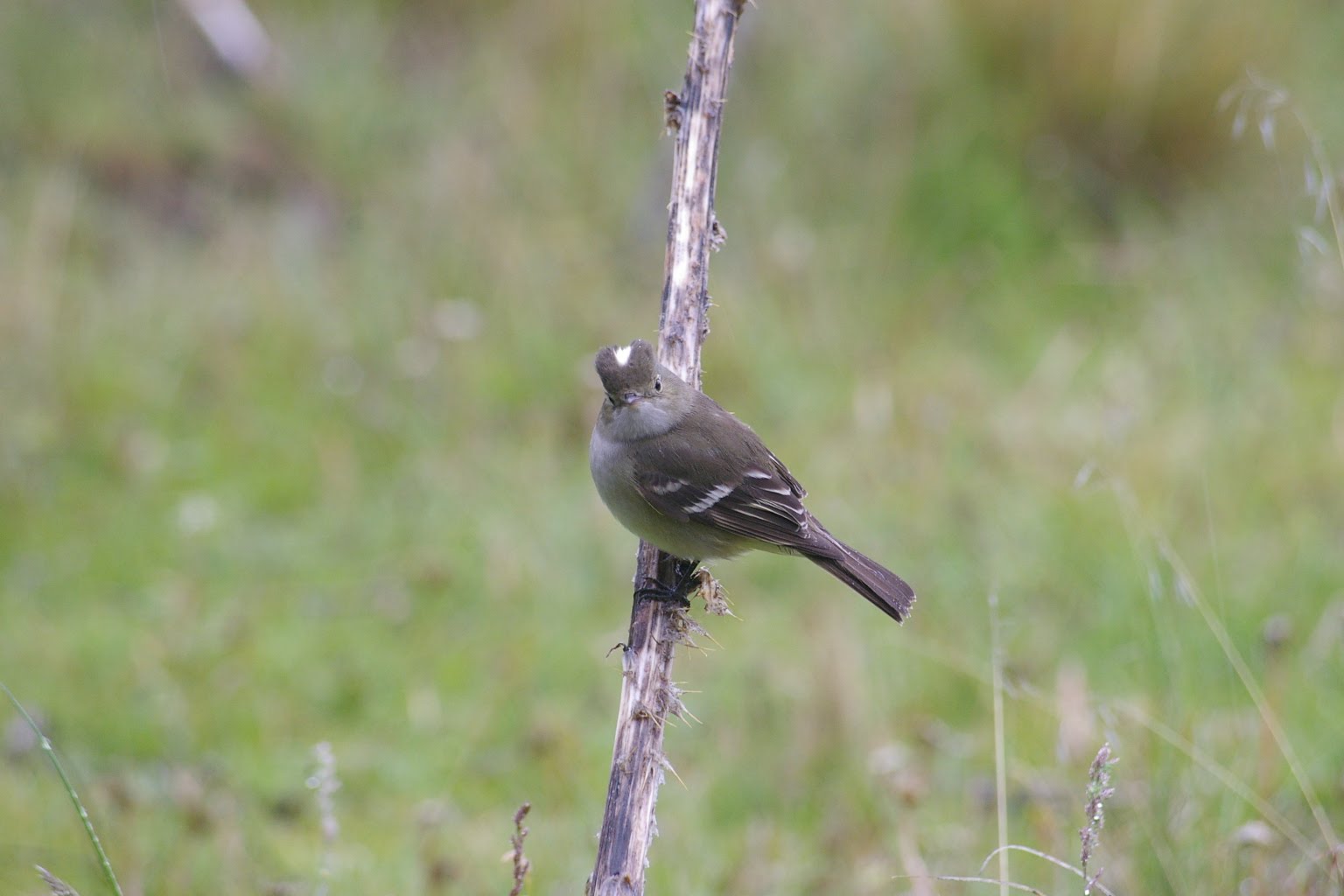
Meanwhile, I do a lot of bird watching when I´m not watching the tucos or the holes from which they pop up. This little girl in the pic, Fio Fio, in Spanish... and I think from the genus, Elainea, or something like that, has been the most noticeable visitor around camp and the field. They´re cute little buggers, which hang on to sticks and watch for bugs, quickly popping down to the ground to snag a bit and then back to their perch. They remind me of kinglets but Claire, you might have to hunt this one down for me. Anyway, they´re quite the chirpers and fun to follow. We also came upon a Loica´s nest. They are like the southern hemisphere´s version of a meadowlark but with a brilliant red chest. They nest on the ground and this nest had a cowbird chick in it and what looked like another cowbird egg along with its own two eggs. Unfortunately, the parents abandoned the nest. I continue to watch our kestrel pair feeding in the lower hollow of a tree and hope to post a short clip soon. They are quite the beautiful birds and their hatchlings are getting quite the gourmet meals, usually consisting of large juicy lizards. Finally, we´ve had our "regular" little gray bird (Doica) show up to fight himself in the truck side mirrors. It´s funny to watch as he flies at the mirror over and over again. From the condors to the swallows, this place is full of amazing birdlife.

We bought our bus tickets for Salta today. It´s a two day bus ride to where we pick up our rental truck and head into the mountains near Jujuy. Should be fun. Also, we will be checking out a site about 150 km from here on reports that another population of C. sociabilis may be there. We´re all doubting this but gonna check just in case. That´s all for now. I´m probably going to be out of touch until Dec. 11 or so as we hope to take advantage of the promised good weather. Hope you´re all staying warm during the winter. I´m betting my spring is colder than your (i.e. California) winter... at least right now. Missing you all ... Julie

Thursday, November 26, 2009

Oh How the Wind Doth Blow!

We’ve been here nearly 3 weeks and only have about 3 to go. It’s a shortened season at this site, but come Dec. 18th, we’re headed to north central Argentina to a place called Jujuy (said Who-Whoee and put some zing into it when you say it). John and Eileen and my labmate, Rachel, went there last May to check out another report of a social tuco. You may recall that we checked out one last year in Tierra del Fuego, but as it turned out, the tuco was a solitary one, though still quite cute (which goes a long way in my book). However, the one in Jujuy IS social and we are headed there to do some serious radio telemetry to better understand group size and composition.

Here, though, we have a lot of work to do in a little time… and the weather is not cooperating. It’s been raining quite a bit and the wind… well, I’ve written plenty in past years about the Patagonian wind. It’s like no other. On top of that, it’s downright freezing. I know I was spoiled last year with warmer than usual weather but really, does it have to be this cold??? Still, I am enjoying the open spaces and the relative quiet.

We’ve caught animals in 4 colonies so far. I even noosed an adult female… thinking it was a large pup! Oh well… she survived my ignorance, though not too happy about it. There have been some cool “Attenborough” moments this past week. We have a pair of American Kestrels nesting in one of the trees in our camp. There´s a hole entering into the cavity about ½ meter from the ground… seems low for a kestrel but they are taking turns flying in and out of it with dead mice and lizards. Fun to watch. Can´t wait until I see baby Kestrel fledglings! Also, the annual mating “fly-off “ of a local ant species happened when I was suppose to be standing very still watching for tucos. I noticed one of the senecio bushes “moving” and saw hundreds of ants crawling their way to the top. There were wingless ants, small winged male ants with their “gifts” to be given to the large winged reproductive females. As soon as the females reached the top of a stem, off they flew and before I knew it, there was a whirlwind of flying ants all around and above me. It´s rather spectacular! There are many more, which I hope to write on next week.

Today I am posting a rather shakey clip of walking back to camp after a long day in the field... to give you an idea of how it feels. Eileen and John are ahead of me and when I stop and turn to take a panoramic view, you can see the Andes, across the "highway" toward the field site, and back toward our camp. Thanks for the emails and comments. Wishing you all a very Happy Thanksgiving!!