Summer! I am going to reinvigorate this blog, now that my life as a graduate student has ended. However, my life as a teacher has begun and the school semesters prove to be just as busy!
I've got lots of fun planned away from home this summer, which I'll write about another time. For now, I am so enjoying being at home, working in my garden, cleaning out the garage and moving toward the goal of living with less.
My fruit trees are all producing (peach, plum, pluot and cherry). Here is a pic of the cherry tree's first production, but I think the robins will get to eat more than I will.
I'm also filling in the gaps of what I started last year with the backyard, planting flowers and veggies. It's been a late start with the veggies and currently limited to tomatoes and squash and a bush bean plant. The strawberries and raspberries from last year are looking good though.
This summer I am sharing my house with four researchers from UC Davis, doing work on sudden oak death. They, along with my two tenants, my daughter, myself, Jack (the dog), Oliver (the cat), and Chinchie (the chinchilla) make for a busy household. It's great to have so much going on! Life is never boring!!
Sunday, June 3, 2012
Wednesday, December 8, 2010
Argentina
i have not been the blogger this year... maybe it's because it's year 7 and i've written about the same things year after year. maybe i am close to being done and am letting go. either way, things here have been very relaxed. we are catching what we can but not freaking out if we don't get everything. i am collecting poop but it probably won't come home with me but stay in a freezer in bariloche until some other trip.
this year is different in that there we are not finding very many pups this year. many colonies have only one or two and they are big. most systems have two adults but not more. we're not sure what happened... was it a harsh winter or early spring or...? still, we had some and the picture of me holding one is proof. meanwhile, back at berkeley, i have found out that we have 5 or 6 more females pregnant. it is a very prolific year in the lab... and more sample sizes for my sibling study!
next week, we wrap it up in bariloche and head to salta/jujuy/abra pampa... up to the 13,000 foot mountains in north central argentina, where we are studying another social tuco. it's a much different landscape with lightening storms nearly every night. pretty cool! hopefully, i'll get a chance to catch up again when we're in mendoza.
Wednesday, November 17, 2010
Back to the Field
We just arrived this morning, after two plane rides and a 22 hour bus ride. Our field truck is still in the shop and we hope it is done by tomorrow so that we can get out to our camp. The picture above is a view from where we set up our tents. Many of you know that this has been a crazy year for me. I taught my first biology class at a nearby university and have been hard at work in the lab and writing to finish my dissertation. At the same time, I have been applying for jobs and was hired to teach marine mammals at Santa Rosa Junior College this spring. I interviewed for a couple of other jobs, one which represents my dream job up in the San Juan Islands. We'll see, but for now, it's time to let go of the crazy stress that defines me in Berkeley and enjoy the wild tucos while the Patagonian wind does it's magic on me yet again.
I hope to keep the blog up but don't know how often we will make it to town... follow along if you want and write me whenever you can. I love it. I think myself very lucky to go on these bio-exploring adventures with the hope that it will never end.
Sunday, October 31, 2010
Wednesday, August 18, 2010
I'm a bad blogger... I left for the San Juans and didn't write a thing after I returned, until now. Life has ramped up. I got a job teaching a biology class. I'm worki
ng on the second chapter of my dissertation. But mostly, I am daydreaming about how to make my way north for good. Every trip to the San Juans makes me consider the idea of moving there, but for some reason, after returning from this trip, I can't let the idea go. It may be that I'm just so burned out from 5 am commutes and 12 hour school days that I need a permanent vacation. It most likely has to do with the fact that I turned 50 this year and I keep thinking of how short life is and how I don't want to get near the end of it and regret not giving life on SJI a shot.
This year's vacation was different in that I stayed two weeks. The first week was spent with an eclectic group of friends, from Berkeley and Washington. We had a full camp with a semi-circle of tents, and we saw orcas every day but one! It was the first year we had a baby come... my dear friend, Annaliese, brought her little guy, Ronan... who is quite the charmer, smiling at everyone he sees. Regardless of who accompanies me on these heavenly vacations, we
always end up making friends with other campers, particularly those who stay in the hiker/biker camps. This year was no different and we met folks from Holland, Hawaii, and various other places, sharing meals and stories and watching orcas from the bluff.
I said goodbye to everyone after a week and my best paddle buddy from Maine, Erika, joined me for the second week. Erika has become my soulmate in orca watching, orca chasing (by car up and down the coast, lest any of you think I meant by kayak!... not that I'm above that...!) and she often sings while we
paddle down the west side toward Limekiln Lighthouse, making the experience a very spiritual one. Though I've only known Erika for 4 years, I can hardly imagine being there without her.
Like the first week, Erika and I made friends with the campers around us. One older man, in particular, Richard, came riding in on his bike alone and pitched his tent across from our tents. We ended up spending time exchanging life stories and opinions, sharing meals and campfires. Richard seemed very happy to hang out with us, content with life and, like us, in awe of the beauty around. Our second day with Richard was Richard's last day on earth. An aortic aneurysm burst and he died being med-evac'd off the island. We later learned that he lived very simply and that most of his gear was all he possessed. He had good friends in Oregon where he worked at a bookstore, and we were fortunate to share with them memories of his last days.
For me, it was a powerful lesson of how important our daily interactions with one another are... whether we are interacting with friends or strangers. We don't know at what point in someone's life we come, but we have the power within us to make the moments we share positive moments. Though I only knew Richard for two days, I will never forget him or what I've learned from him. And I hope that, whether I make my home here in California or up north tucked away on an island, I will cherish each day and each person that comes into my life.
That was my trip this year.
This year's vacation was different in that I stayed two weeks. The first week was spent with an eclectic group of friends, from Berkeley and Washington. We had a full camp with a semi-circle of tents, and we saw orcas every day but one! It was the first year we had a baby come... my dear friend, Annaliese, brought her little guy, Ronan... who is quite the charmer, smiling at everyone he sees. Regardless of who accompanies me on these heavenly vacations, we
always end up making friends with other campers, particularly those who stay in the hiker/biker camps. This year was no different and we met folks from Holland, Hawaii, and various other places, sharing meals and stories and watching orcas from the bluff.I said goodbye to everyone after a week and my best paddle buddy from Maine, Erika, joined me for the second week. Erika has become my soulmate in orca watching, orca chasing (by car up and down the coast, lest any of you think I meant by kayak!... not that I'm above that...!) and she often sings while we
paddle down the west side toward Limekiln Lighthouse, making the experience a very spiritual one. Though I've only known Erika for 4 years, I can hardly imagine being there without her.Like the first week, Erika and I made friends with the campers around us. One older man, in particular, Richard, came riding in on his bike alone and pitched his tent across from our tents. We ended up spending time exchanging life stories and opinions, sharing meals and campfires. Richard seemed very happy to hang out with us, content with life and, like us, in awe of the beauty around. Our second day with Richard was Richard's last day on earth. An aortic aneurysm burst and he died being med-evac'd off the island. We later learned that he lived very simply and that most of his gear was all he possessed. He had good friends in Oregon where he worked at a bookstore, and we were fortunate to share with them memories of his last days.
For me, it was a powerful lesson of how important our daily interactions with one another are... whether we are interacting with friends or strangers. We don't know at what point in someone's life we come, but we have the power within us to make the moments we share positive moments. Though I only knew Richard for two days, I will never forget him or what I've learned from him. And I hope that, whether I make my home here in California or up north tucked away on an island, I will cherish each day and each person that comes into my life.
That was my trip this year.
Saturday, June 12, 2010
How Does Your Garden Grow?
I was taking care of John and Eileen's garden and harvesting (and eating) the sugar snap peas and became addicted... so I've got seeds started and am going to build a structure for
them to climb so they can give me lots of peas! No fruit on the fruit trees but I am not expecting any this first year. The squash has numerous baby squashes on it and I'm afraid I will miss the first harvest as I leave on a 2 week trip to the San Juans this Tuesday. Hopefully the kids will eat them.We've enjoyed the lettuces and some spinach but I did have to deal with a nasty little pest, the leaf miner, and I've noticed aphids on my broccoli! Still, I think I am ahead in having a pretty successful first garden. Even the corn is beginning to grow. More in a couple of weeks when I return from kayaking with the orcas, my favorite thing to do each solstice.
Saturday, May 29, 2010
birthday presents
apparently, she did at some point.
anyway, they are the cutest things ever. we had 3 but lost one. the two little ones are doing well and, as they get bigger, are hopping all over. there's nothing quite as cute as a baby animal!
Friday, May 14, 2010
Life at 50
Okay... well, I won't be 50 until next week, the very thought makes me tremble a little. It's not like one week matters but it's really difficult to think of myself in an age group I've always considered old.
I know. I know. 50 is the new 40, but tell that to the body! I know. I know. It's only a number. Your age is in your mind, spirit, soul, but again, I kind of wish it was in the body too!
Still, how can I complain? I may not be the same person I was 20 years ago, but I am happy and grateful for all that I've gotten to do in this life. I have four amazing kids. I have the best friends and family anyone could wish for. I kayak with orcas every year. I live in one of the b
est towns in the U.S. (Sebastopol) in a house with a huge yard to garden (not to mention redwood trees and oak trees). I go to UC Berkeley and travel to Argentina every year to do fieldwork. I'm getting my first chapter published this year... woo hoo! (see pic below)
And before I turn 51, I will get my PhD. The first half of my 50th year will be spent feverishly finishing my thesis and the se
cond half will be spent begging for work (so I can keep the house, garden and the ability to go kayaking!).
I've had a good ride... certainly with some serious rocky moments, but overall, life at 50 is, indeed, pretty spectacular. Here's to the next 50, um... make that 30+ or so!
p.s. yes, that's me with a kayak paddle, a hoe and a hand shovel in the top picture, showing off my garden with my favorite tools (though I only use the paddle in the ocean).

Still, how can I complain? I may not be the same person I was 20 years ago, but I am happy and grateful for all that I've gotten to do in this life. I have four amazing kids. I have the best friends and family anyone could wish for. I kayak with orcas every year. I live in one of the b
est towns in the U.S. (Sebastopol) in a house with a huge yard to garden (not to mention redwood trees and oak trees). I go to UC Berkeley and travel to Argentina every year to do fieldwork. I'm getting my first chapter published this year... woo hoo! (see pic below)And before I turn 51, I will get my PhD. The first half of my 50th year will be spent feverishly finishing my thesis and the se
I've had a good ride... certainly with some serious rocky moments, but overall, life at 50 is, indeed, pretty spectacular. Here's to the next 50, um... make that 30+ or so!
p.s. yes, that's me with a kayak paddle, a hoe and a hand shovel in the top picture, showing off my garden with my favorite tools (though I only use the paddle in the ocean).
Sunday, March 28, 2010
Kayak Zen
Finally, I turned to head back in though the jetty to the harbor where I started. Gulls, cormorants, willets, surf birds, oyster catchers, and black turnstones were hanging about, warming in the sun's rays. A sea lion was headed out with the tide, probably to join his buddies at the rock. I love taking people kayaking, but these Sunday mornings are special spent alone. My thoughts have had a chance to follow their path until nothing is left but the pure pleasure of being. How fortunate I am to be able to do this. I'll try not to forget what it means to me the next chilly Sunday morning.
Sunday, March 7, 2010
Spring-Like Inspirations
Yesterday, I journeyed up to Sacramento to visit a friend, who actually was my invert zoology teacher when I was still an undergrad at Berkeley. Marlene is a great teacher, but she's also a fantastic friend, who I don't see enough of. I call her my laughing friend, because there's no one who I laugh with as much as I do when I'm with her. That's actually saying a lot... because I laugh with a lot of you! Anyway, our day together turned out to be, not only full of laughter, but inspiration for gardening this spring. I've been talking about turning my backyard into a "food basket" by growing lots of vegies and herbs and maybe a few fruit trees. When I saw that Marlene had put 22 fruit trees into her backyard, one that's half as big as mine, I was astounded! Plus, she still grows herbs and vegies and flowers too.
She took me to her favorite nursery and with the help of some very knowledgeable nursery guys, I purchased 3 fruit trees, some raspberry canes, and a few flowers. This morning I woke up to beautiful blue skies and sunshine and an eagerness to plant. I only got the fruit trees in but will hopefully get the rest in sometime during the week. Meanwhile, Jack, the dog, took a great interest in all my digging... and I'm afraid I will have to watch him closely so that he doesn't undo my hard work.
The goal is to eventually have enough fruit trees so that I am picking something ripe and ready every season of the year. Do you think it's possible? The nursery guy said it was!

Above is a picture of Beth, playing the role of Vanna White, pointing out the Peach, the Pluot, and the Plum trees... oh and Jack, the dog, wistfully wanting to dig!
She took me to her favorite nursery and with the help of some very knowledgeable nursery guys, I purchased 3 fruit trees, some raspberry canes, and a few flowers. This morning I woke up to beautiful blue skies and sunshine and an eagerness to plant. I only got the fruit trees in but will hopefully get the rest in sometime during the week. Meanwhile, Jack, the dog, took a great interest in all my digging... and I'm afraid I will have to watch him closely so that he doesn't undo my hard work.
The goal is to eventually have enough fruit trees so that I am picking something ripe and ready every season of the year. Do you think it's possible? The nursery guy said it was!
Above is a picture of Beth, playing the role of Vanna White, pointing out the Peach, the Pluot, and the Plum trees... oh and Jack, the dog, wistfully wanting to dig!
Saturday, February 20, 2010
Class Field Trip to Pt. Reyes National Seashore
The class is learning about how biologists study animal behavior, in class, in lab and in the field. My advisor, Eileen Lacey, is the professor, and together with the two GSI's, we took them to a place called Chimney Rock, famous for the elephant seal haul out where male seals establish territories in order to watch over their harem. The students got a chance to observe males duking it out for access to the females who had finished nursing their pups and were going into estrous.
Elephant seals are amazing marine mammals. They can dive to depths of 2000 feet and hold their breath for half an hour. Some have surpassed even that. Their physiology is the subject of many studies and scientists are continually intrigued by how they are able to withstand the tremendous pressures of the deep sea. Elephant seals haul out for a period of time twice a year, in the winter for breeding and in the summer for molting. The rest of the time, they are out to sea feeding. The males head off toward the Aleutians while the females feed in the open Pacific or Hawaii. These animals were once hunted to near extinction but after given official protection, have rebounded to substantial population numbers and are still growing.
The purpose of today's field trip was to give the students a chance to observe elephant seal behavior, to construct an ethogram by naming and defining behaviors, and then to ask a question and develop hypotheses about interactions between males and females, males and males, females and females. Next, they were to choose one of 3 data collecting techniques they had learned about earlier in orde
Tuesday, February 9, 2010
Hyenas
So, I'm diverting a bit from Argentina to go to Africa... ok, not really. Believe it or not, we have hyenas in Berkeley! Today, our sophomore seminar class went to visit them at the field station in the hills behind campus. These are some of the most amazing beasts I have ever seen, and though I've been privileged to get to visit them fairly often with class field trips, it never ceases to amaze me how cool these guys are, especially for those of us who study hormones and behavior.
The spotted hyena (Crocuta crocuta) is native to Kenya but for the past 25 years, there's been a colony housed in a large facility above campus. One of their big claims to fame is the high levels of androgens that are present in females, causing masculinization of the genitalia. In other words, the girls don't look much different than the boys! Hyenas live in a female dominated society where the higher you are in rank, the better access to food and other resources you have. Males disperse from their natal colony to seek matings with females from other colonies. The lucky ones get the higher ranked females, whose offspring will inherit the rank of their mom.
The benefits of this abundance of androgens is that females are large and powerful but there are costs too. Birthing cubs is extremely difficult and often, the first cub to be born dies. If more than one cub is born, they come out fighting, sometimes to the death ... having been bathed in utero in this hormone that seems to be associated with aggression. Much of this research has been done using the hyena colony at Berkeley, and in fact, it is the only one of its kind in the world.
Hyenas are fascinating and as much as I would love to pet one, their massive jaws warn me off, especially after watching a demonstration of their ability to crush huge cow bones. Still, the Berkeley hyenas seem to have a playfulness that I can enjoy behind the fence. Their whooping and laughing and chasing one another are fun to watch on any day in Berkeley... as it was today.
Thursday, February 4, 2010
Camelids and Cuys
One of my favorite mammals, which we found scurrying around the galpon, or storage building where we did our cooking, was the cuy, a cute little wild guinea pig. I tried to get close but these guys are extremely shy and would run into a nearby hole or tunnel to hide. This picture was actually taken through the window of the galpon.
Sunday, January 31, 2010
The Tucos of Los Pozuelos
Last May, John and Eileen and Rachel, my labmate, went to the Los Pozuelos field site for the first time. They had been told by Pablo Cuello, a grad student in the university at Mendoza, Argentina, who had assisted us the year before and knew what a social tuco was, that the tucos he was seeing at this high altitude location looked suspiciously social. Not only were there lots of them in one area, one or more adults could be seen coming out of the same hole. It didn't take John and Eileen long, once they got there, to see that the tucos were social, and one of the primary reasons for this second trip was to confirm by radio telemetry that the areas individuals were using really did overlap.
Tissue sample was collected last May and we are still waiting for the genetic results from the lab in Mendoza but originally, this species was identified as Ctenomys opimus, which, from observations in other places, was characterized as a solitary animal. We are anxious to find out where this animal places in the known species of Ctenomys and if it truly is opimus or some subspecies or perhaps, something altogether different. Any of those possibilities are exciting... however, one thing is certain, the tucos that live in this area are social but do not exhibit the same social patterns we see in C. sociabilis in Patagonian Argentina.
In C. sociaibilis, we find females living in distinct colonies along with one adult male. Here, after MANY hours of radio telemetry (just ask Anna, the grad student who came out to join us!), we found that multiple males and multiple females overlap in the areas they use but not completely. The data are still being picked apart and analyzed but it looks like there are distinct groups but the groups don't necessarily inhabit the same space all the time. In addition, we did 3 nights of radio telemetry. There were 22 animals with radio collars and every hour on the hour all through the night and day, fixes were being made so we knew exactly where each individual was for that moment. This was no small feat... and I had to ask myself more than once, what the heck an almost 50 year old woman was doing out in the middle of nowhere in the middle of the night stumbling around in the dark with an antenna in her hand looking for a rodent!
However, we did collect a lot of information and are trying to better understand the unique society this mystery tuco participates in. The other big question we are asking is what the mating and breeding cycle is. Last May, they found fairly large pups. In January, we saw a number of pregnant females but also some decent sized pups. The picture in this post is one of them. Do these tucos breed multiple times through the year? Or are females on different reproductive cycles? With multiple males living in the same group, is there competition for mating or is there one male dominating? Who disperses? Who stays? Although I found this place to be a rather intense field site, I have to admit that these tucos intrigue me. There are so many things to discover, and discovering the stories of animals is what excites me most in biology. More to tell in the next post!
Monday, January 25, 2010
Field Site #2
The field site here was so much different than what I have experienced in Patagonia. The tucos live next to a river in a gravelly soil with low growing vegetation. There are no trees and no shade. We were there in the wet season, and often, the clouds gathered every afternoon. Sometimes there was rain but always there was lightning and thunder. The high altitude (~13,000 ft) was a challenge but coca leaves and aspirin helped with the headaches, and in time, even the sluggish feeling left. The glare of the afternoon sun was overwhelming and the only relief was to sit in the truck.
The days were spent watching tucos, catching tucos, collaring tucos with radios and tracking them with telemetry. Often we were out for 12+ hours. It was rather intense, especially after having just completed a field season elsewhere. Still, a ton of data was collected and a lot was learned. Next posting, I'll write about these mysterious tucos, which we know are social but don't know what species they are.
Sunday, January 17, 2010
On the Beach
Well, it's been nearly a month now and I haven't posted a thing. You'd think from these pictures, I've only been relaxing and playing but inbetween, there's been a heck of a lot of field work in a completely different Argentina than I have seen before. Over the next couple of weeks, I will post the story of Jujuy or really, north of Jujuy, in a place called Los Pozuelos where we spent 3 weeks catching a tuco whose identity is not clearly known. The field site is a much harsher landscape than what I'm use to down near Bariloche, but the tucos are fascinating. They are definitely social but with different social habits than sociabilis.
I arrived in Mar del Plata, a city south of Buenos Aires and known as one of the hot vacation spots in Argentina, on 12 Jan after depositing my paperwork for permits in Buenos Aires. John, Anna and I (Eileen has gone home to teach classes) are hanging on the beach with good friends, Ana Paula and Alfredo, relaxing, eating asado and John is in heaven playing volleyball. I know you all feel sorry for me... not! But really, besides still missing home, I have come down with some stomach "bug" which has not made the time entirely perfect. Fortunately, Alfredo is a doctor and I am hoping the meds he suggested will work. Anna (fellow student from Berkeley) and I will head back to BA on Tuesday to finish up with permits and meet John for our flight home on Wednesday night. I have much more to tell and great pics to post over the next few weeks. Thanks for all the comments and emails... no worries to those of you who find this blog thing a bit complicated. Soon!
Friday, December 18, 2009
Moving On

On Tuesday, we packed up camp and left our refuge in the willows for new adventures. The season with C. sociabilis went fast, and tomorrow, we head for the north part of Argentina to investigate another social tuco-tuco. The past few days were spent outside a small town, El Maiten, south of Bariloche. Years ago, some professional animal collectors found a bunch of tucos living in a valley. Their report was that these tucos were up everywhere and "chirped like birds". That's classic sociabilis. Since then, some local mammalogists checked out the area and found burrows but did not see the animals. We went to see for ourselves just what tuco was living there. As it turned out, it was C. haigi, a solitary tuco known around Bariloche. Even though this species is found close to where we find soci, I had not yet met haigi up close and personal. We caught a mom and her pups and two males. They communicated more with grunts, rather than chirps, and were quite docile.
Today's picture shows John and Eileen on one of our last nights in camp. Like I said, the weather finally turned warm and we were often eating dinner outside. John has taken up guitar playing and brought his travel guitar with him, practicing all the time. Eileen, of course, continues to work even "after hours". By 9 pm or so, we hunker down in the truck for our nightly video of House. We're now on Season 3, and watching it has become our favorite tuco team past-time. I am hoping to post some more from Jujuy and parts north, but until then, I send my wishes to you all for a wonderful Christmas. Cross your fingers for me on Tuesday... we head to 14,000+ feet altitude and I am hoping that I don't get sick! From Bariloche, Felices Fiestas!!
Wednesday, December 9, 2009
Spring, Glorious Spring

Finally, spring has arrived in the Limay River Valley! It has turned wonderfully warm, so warm that the wind is a welcome friend. We’ve had a few sprinkles of rain but the temps are good enough to take a bath in the stream. We are now upon our last week of field work for C. sociabilis. It has been an interesting field season, surprising with who we’ve found has survived. Overall, older females seemed to do better than yearlings and even more of a surprise, there has been an adult male in nearly every colony! Those of you who know the tuco-tuco story know that male survival is quite low in this species, and in fact, we rarely encounter an adult male. It’s a good year when about 40% of the colonies have a male. So why such a difference this year? While they had rain in May (their Fall), they had little rain through the winter when tucos are mating. Perhaps, mortality was very high for last year’s litters, but I’m not sure if lowered competition for the males gave those remaining a better chance at survival. Who knows? But we also have seen a strong male sex ratio bias in the pups. And finally, I have only come across one lone female. The rest are living in groups this year. I have seen this downward trend toward fewer and fewer females living alone over the past 6 years. I am anxious to go back over the data to see if there may be a pattern that emerges with weather, yearling survival, sex ratio and number of lone to group colonies.
Today’s photo show a little pup and his generous donation to my dissertation cause. I do need more than one poop to get a sufficient sample of CORT hormones but he came through with more! I’ve collected a fair amount of samples and will add it to what I’ve already analyzed in the lab. In general, I have found that group living females have lower baseline CORT (or stress) hormones than females living alone. I have also found that CORT in pups is also high or low depending on living with a lone mom or group living moms. How much of that is inherited or passed through mom’s milk is yet to be known, but it is interesting to me. With the help of the best undergrad “wranglers” ever, I continue to run behavior tests with the pups in the lab at Berkeley, looking to see if behavior and hormones are correlated. Specifically, I am testing exploratory or bold behavior in an open arena in which they have the option of running around or hiding in a refuge. We have found in the adult lab females that there’s a strong correlation with CORT and boldness. That is, lower CORT, higher exploratory behavior. We’ll see how this holds with the pups.
We leave in about 5 days for a place called Chubut to check out a possible population of C. sociabilis. It’s been rumored that there use to be some living in this region south of Bariloche. We’ll be breaking camp on the 15th, head down to Chubut for a few days and then back to Bariloche, where we catch the bus to Salta. There we will rent a truck and head into the mountains near Jujuy and I will get to meet another social tuco-tuco!
Tuesday, December 1, 2009
Wind-worn
We made a last minute decision to come into town today, only because we´ve gone two days now with such high winds and intermittent rain, that we´ve been unable to trap tucos. The good news is that the weather is suppose to turn warm. Cross your fingers! We have about 5 more colonies to go.
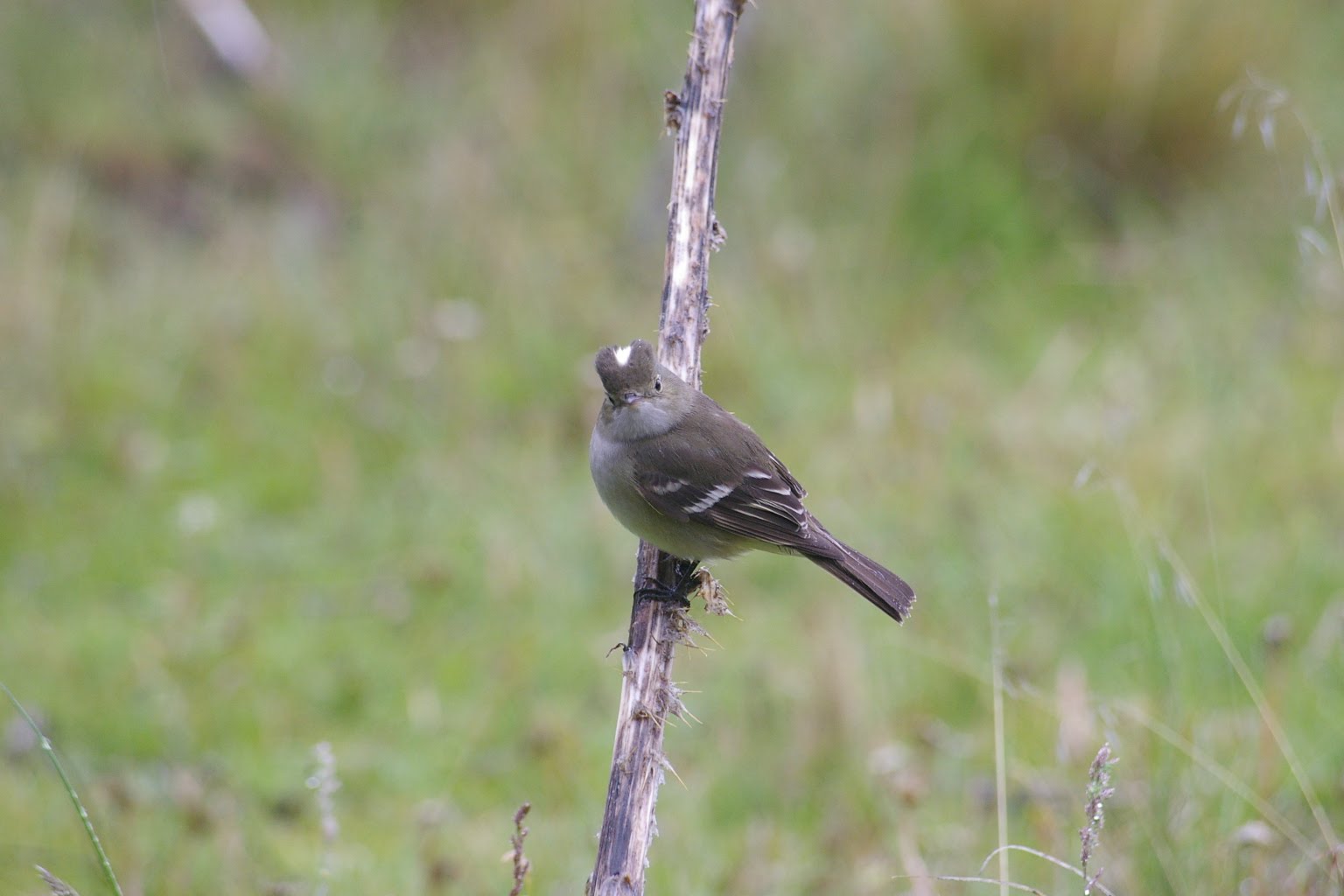
Meanwhile, I do a lot of bird watching when I´m not watching the tucos or the holes from which they pop up. This little girl in the pic, Fio Fio, in Spanish... and I think from the genus, Elainea, or something like that, has been the most noticeable visitor around camp and the field. They´re cute little buggers, which hang on to sticks and watch for bugs, quickly popping down to the ground to snag a bit and then back to their perch. They remind me of kinglets but Claire, you might have to hunt this one down for me. Anyway, they´re quite the chirpers and fun to follow. We also came upon a Loica´s nest. They are like the southern hemisphere´s version of a meadowlark but with a brilliant red chest. They nest on the ground and this nest had a cowbird chick in it and what looked like another cowbird egg along with its own two eggs. Unfortunately, the parents abandoned the nest. I continue to watch our kestrel pair feeding in the lower hollow of a tree and hope to post a short clip soon. They are quite the beautiful birds and their hatchlings are getting quite the gourmet meals, usually consisting of large juicy lizards. Finally, we´ve had our "regular" little gray bird (Doica) show up to fight himself in the truck side mirrors. It´s funny to watch as he flies at the mirror over and over again. From the condors to the swallows, this place is full of amazing birdlife.
We bought our bus tickets for Salta today. It´s a two day bus ride to where we pick up our rental truck and head into the mountains near Jujuy. Should be fun. Also, we will be checking out a site about 150 km from here on reports that another population of C. sociabilis may be there. We´re all doubting this but gonna check just in case. That´s all for now. I´m probably going to be out of touch until Dec. 11 or so as we hope to take advantage of the promised good weather. Hope you´re all staying warm during the winter. I´m betting my spring is colder than your (i.e. California) winter... at least right now. Missing you all ... Julie
Thursday, November 26, 2009
Oh How the Wind Doth Blow!
We’ve been here nearly 3 weeks and only have about 3 to go. It’s a shortened season at this site, but come Dec. 18th, we’re headed to north central Argentina to a place called Jujuy (said Who-Whoee and put some zing into it when you say it). John and Eileen and my labmate, Rachel, went there last May to check out another report of a social tuco. You may recall that we checked out one last year in Tierra del Fuego, but as it turned out, the tuco was a solitary one, though still quite cute (which goes a long way in my book). However, the one in Jujuy IS social and we are headed there to do some serious radio telemetry to better understand group size and composition.
Here, though, we have a lot of work to do in a little time… and the weather is not cooperating. It’s been raining quite a bit and the wind… well, I’ve written plenty in past years about the Patagonian wind. It’s like no other. On top of that, it’s downright freezing. I know I was spoiled last year with warmer than usual weather but really, does it have to be this cold??? Still, I am enjoying the open spaces and the relative quiet.
We’ve caught animals in 4 colonies so far. I even noosed an adult female… thinking it was a large pup! Oh well… she survived my ignorance, though not too happy about it. There have been some cool “Attenborough” moments this past week. We have a pair of American Kestrels nesting in one of the trees in our camp. There´s a hole entering into the cavity about ½ meter from the ground… seems low for a kestrel but they are taking turns flying in and out of it with dead mice and lizards. Fun to watch. Can´t wait until I see baby Kestrel fledglings! Also, the annual mating “fly-off “ of a local ant species happened when I was suppose to be standing very still watching for tucos. I noticed one of the senecio bushes “moving” and saw hundreds of ants crawling their way to the top. There were wingless ants, small winged male ants with their “gifts” to be given to the large winged reproductive females. As soon as the females reached the top of a stem, off they flew and before I knew it, there was a whirlwind of flying ants all around and above me. It´s rather spectacular! There are many more, which I hope to write on next week.
Today I am posting a rather shakey clip of walking back to camp after a long day in the field... to give you an idea of how it feels. Eileen and John are ahead of me and when I stop and turn to take a panoramic view, you can see the Andes, across the "highway" toward the field site, and back toward our camp. Thanks for the emails and comments. Wishing you all a very Happy Thanksgiving!!
Here, though, we have a lot of work to do in a little time… and the weather is not cooperating. It’s been raining quite a bit and the wind… well, I’ve written plenty in past years about the Patagonian wind. It’s like no other. On top of that, it’s downright freezing. I know I was spoiled last year with warmer than usual weather but really, does it have to be this cold??? Still, I am enjoying the open spaces and the relative quiet.
We’ve caught animals in 4 colonies so far. I even noosed an adult female… thinking it was a large pup! Oh well… she survived my ignorance, though not too happy about it. There have been some cool “Attenborough” moments this past week. We have a pair of American Kestrels nesting in one of the trees in our camp. There´s a hole entering into the cavity about ½ meter from the ground… seems low for a kestrel but they are taking turns flying in and out of it with dead mice and lizards. Fun to watch. Can´t wait until I see baby Kestrel fledglings! Also, the annual mating “fly-off “ of a local ant species happened when I was suppose to be standing very still watching for tucos. I noticed one of the senecio bushes “moving” and saw hundreds of ants crawling their way to the top. There were wingless ants, small winged male ants with their “gifts” to be given to the large winged reproductive females. As soon as the females reached the top of a stem, off they flew and before I knew it, there was a whirlwind of flying ants all around and above me. It´s rather spectacular! There are many more, which I hope to write on next week.
Today I am posting a rather shakey clip of walking back to camp after a long day in the field... to give you an idea of how it feels. Eileen and John are ahead of me and when I stop and turn to take a panoramic view, you can see the Andes, across the "highway" toward the field site, and back toward our camp. Thanks for the emails and comments. Wishing you all a very Happy Thanksgiving!!
Subscribe to:
Comments (Atom)
